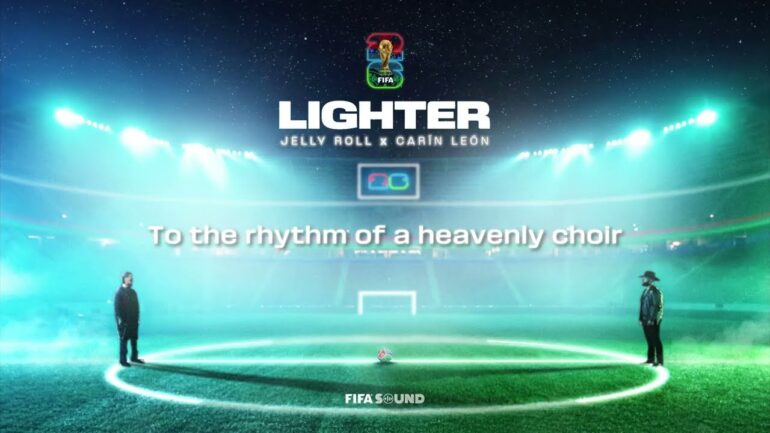

Jelly Roll Featuring Carin Leon sings Fifa 2026 theme song, “Lighter.”
There was a time, not so long ago, when the sound of the FIFA World Cup was defined by a very specific kind of polished, universalist pop. From the hip-swiveling charisma of Ricky Martin’s “The Cup of Life” to the stadium-sized euphoria of Shakira’s “Waka Waka,” the tournament’s sonic identity was built on “global pop”—a genre that often smoothed over local textures in favor of a catchy, polyglot chorus that could be hummed from Tokyo to Toronto. It was safe, it was bright, and it was intentionally disconnected from the grit of regional subcultures.
Fast forward to the announcement of the 2026 official theme, “Lighter,” featuring Jelly Roll and Carín León. The contrast is jarring. In place of the traditional pop star archetype, we have a heavily tattooed former rapper from Nashville who conquered the country charts through raw tales of incarceration and addiction, paired with a Sonoran powerhouse who has spent the last five years dismantling the boundaries of música mexicana.
This isn’t just a change in tempo; it is a total recalibration of what “global” means. By selecting “Lighter,” FIFA has moved away from the sanitized “United Nations of Pop” aesthetic and leaned into a gritty, cross-border authenticity that mirrors the complicated reality of the 2026 host nations. It is a transition from the aspirational to the experiential, signaling that the world’s most-watched event is finally ready to embrace the aesthetic of the underdog.
The Trajectory of the Outlaw and the Rebel
The path to “Lighter” was paved by two artists who spent the early parts of their careers being told they were “too niche” or “too regional” for the mainstream.
Jelly Roll’s early reputation was forged in the independent hip-hop scene of Tennessee, characterized by mixtapes that leaned heavily into the “outlaw” trope. He was an artist of the periphery, writing for a demographic that saw themselves in his struggles with the legal system and substance abuse. For years, his presence in the “mainstream” was non-existent. The mid-period shift occurred around 2021, when he pivoted toward a country-rock hybrid with “Son of a Sinner.” This wasn’t a corporate rebranding but a vocal maturation; he found that his story resonated more deeply when paired with the vulnerability of a pedal steel guitar than the bravado of a trap beat.
Carín León followed a parallel trajectory of disruption. Initially a member of Grupo Arranke, León broke out as a solo artist by refusing to stick to the rigid tropes of norteño or banda. He became a symbol of the “música mexicana” explosion, a movement documented by Billboard as a fundamental shift in global listening habits. His work often blended the traditional soul of Mexico with influences from soul, blues, and even rock and roll.
The crystallization of this new narrative occurred in early 2026. As the World Cup approached, the industry expected a high-energy dance track from a marquee DJ or a reggaeton superstar. Instead, the collaboration on “Lighter” presented a mid-tempo, soulful anthem that prioritizes lyrical weight over danceability. It was a clear statement: the 2026 tournament would be defined by the “North American” identity—not as a monolith, but as a messy, beautiful intersection of Nashville and Hermosillo.
Friction at the Intersection of Cultures
As with any significant aesthetic pivot, “Lighter” has not been without its detractors. The initial backlash stemmed from traditionalists on both sides of the aisle. Some soccer purists, accustomed to the high-energy “stadium anthems” of the past, found the track’s introspective tone too somber for a celebratory tournament. On social media, fans questioned whether a “country singer” and a “regional Mexican artist” could truly capture the spirit of a tournament that includes nations from Senegal to South Korea.
Media framing initially leaned into the “odd couple” narrative. Outlets like Variety and Rolling Stone highlighted the geographical proximity of the artists’ roots, but early reviews often struggled to categorize the sound. Was it a country song? A ballad? A Latin crossover?
Peer reactions, however, have been tellingly supportive. Artists within the Nashville and Latin music communities have hailed the track as a victory for “genre-less” music. The controversy isn’t about the quality of the song, but about the disruption of expectations. We are witnessing a clash between the old-world demand for “global homogeneity” and the new-world reality of “hyper-local crossover.” FIFA is no longer trying to make everyone sound the same; they are betting that the specific, authentic stories of these two men will translate more powerfully than a generic “go-team-go” chorus ever could.
The Strategy of Vulnerability
In interviews leading up to the release, both artists have been surprisingly candid about the weight of this responsibility. Jelly Roll, speaking to The New York Times, noted that he felt his inclusion was a “nod to the people who never thought they’d be invited to the party.” He acknowledged that the song’s theme—shedding the weight of the past to find a “lighter” future—was a deliberate choice to move away from the aggressive posturing often associated with sports.
Carín León echoed this sentiment in a Vogue feature, stating that the goal was “not to make a hit, but to make a bridge.” This admission is crucial. It suggests that the motivation behind “Lighter” wasn’t just commercial reach, but a calculated effort to define a new kind of “cultural authority.” They aren’t performing as global icons; they are performing as themselves, under the assumption that their individual journeys toward redemption and creative freedom are the most “universal” stories they can tell.
This transparency effectively neuters the “industry plant” accusations that often dog major event themes. By framing the song as a personal confession rather than a corporate mandate, they have secured a level of credibility that past World Cup artists—often accused of “touring” a culture for the duration of a tournament—frequently lacked.

Zooming Out: The End of the Genre Border
The selection of “Lighter” reveals a profound shift in the modern media ecosystem. We are moving past the era of “Global Pop” and into the era of “Regional Dominance.”
In the 2000s, an artist had to “cross over” by changing their sound to fit a Western, English-speaking mold. Today, the data proves that authenticity is the ultimate currency. As Spotify’s “Loud & Clear” reports have consistently shown, regional genres are the fastest-growing sectors of the industry. People don’t want a “watered-down” version of a culture; they want the real thing, even if they don’t speak the language.
This situation also highlights the contest for cultural authority. FIFA, an organization often criticized for its top-down, bureaucratic nature, is using Jelly Roll and Carín León to borrow “outlaw” credibility. It is a classic exchange: the institution provides the platform, and the artists provide the soul. In an age where audiences are increasingly skeptical of corporate branding, “Lighter” serves as an aesthetic shield, suggesting that the 2026 World Cup is “for the people” because its music sounds like the people.
The themes of “relevance vs. legacy” are also at play. For Jelly Roll, this is the ultimate validation of a decade spent in the trenches. For León, it is a stake in the ground for Mexican music on the world stage. They are no longer just “artists”; they are ambassadors of a cultural moment where the “center” of the music world has shifted from Los Angeles and London to the rural South and the Mexican borderlands.
A Weightless Future?
As the 2026 World Cup approaches, the success of “Lighter” will ultimately be measured not by Billboard charts, but by its resonance in the stands. Will a stadium in Mexico City or a fan zone in New York feel the same “weightlessness” the song promises?
The strategy of choosing Jelly Roll and Carín León is a high-stakes gamble on the power of the individual narrative. It assumes that the world is tired of the spectacle and hungry for the sincere. In a cultural landscape that is increasingly fragmented and cynical, “Lighter” stands as a testament to the idea that the most global thing an artist can be is themselves.
Whether this positioning carries weight in the long run remains to be seen. If the tournament becomes mired in the usual corporate controversies, the “outlaw” spirit of its theme song may begin to feel like a performance rather than a reality. But for now, as the voices of Nashville and Sonora blend over a global broadcast, it feels as though the borders of the musical world have finally begun to dissolve. The song is called “Lighter,” and for the first time in a long time, the burden of being “global” feels like it’s finally being lifted.