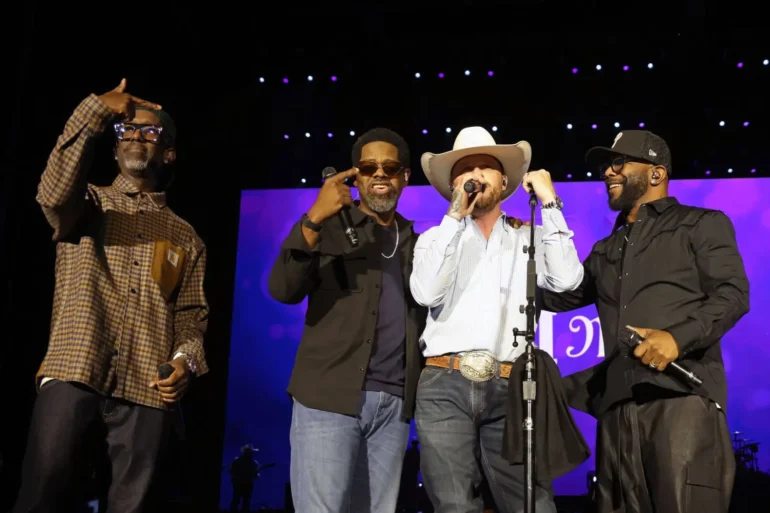
The sight of Boyz II Men, the R&B titans synonymous with smooth harmonies and heartfelt ballads, joining country star Cody Johnson on stage at the Stagecoach festival for a rendition of their iconic hit ‘On Bended Knee’ presents a striking image. It’s a moment that, on its surface, might seem like a simple, feel-good cross-genre collaboration. However, beneath the surface, it reveals a more complex interplay of cultural currency, the evolving definitions of artistic authenticity, and the relentless pursuit of relevance in an increasingly fractured entertainment landscape. For a group whose legacy is so deeply entrenched in the sonic textures and emotional narratives of 90s R&B, this appearance signals a significant pivot, or at least an intriguing expansion, of their public persona and strategic positioning.
Boyz II Men, comprised of Nathan Morris, Sean Stockton, Wanya Morris, and the late Michael McCary, first rose to prominence in the early 1990s, swiftly becoming one of the most commercially successful vocal groups of all time. Their signature sound, characterized by intricate harmonies, sophisticated vocal arrangements, and a romantic, often soulful, lyrical content, defined an era. Hits like ‘Motownphilly,’ ‘End of the Road,’ and ‘I’ll Make Love to You’ dominated charts and solidified their status as R&B royalty. Their early work was deeply rooted in the traditions of soul and R&B, aligning them with artists like Jodeci, Bell Biv DeVoe, and a pantheon of vocal groups that prioritized vocal prowess and emotional depth. Their image was one of sophisticated romance and undeniable vocal talent, a stark contrast to the rawer, more narrative-driven storytelling often associated with country music.
The mid-periods of their career saw the group navigate the changing tides of the music industry. While they continued to release music and tour, the landscape shifted dramatically with the rise of hip-hop and a broader diversification of popular music genres. Boyz II Men, like many artists of their generation, faced the challenge of maintaining their core identity while adapting to new trends. They largely remained faithful to their R&B roots, focusing on live performances and appealing to their established fanbase. Occasional forays into different sounds or collaborations were often met with interest but rarely redefined their core public perception. Their reputation remained largely intact as a beloved purveyor of classic R&B, a reliable source of nostalgia and polished vocal performances.
The recent Stagecoach performance with Cody Johnson, however, represents a more deliberate and public engagement with a genre that, at least on the surface, seems diametrically opposed to their own. Johnson, a successful country artist known for his traditionalist approach and honky-tonk roots, is far removed from the urban soundscapes of Philadelphia where Boyz II Men first found their footing. The decision to perform ‘On Bended Knee’ – a song that is quintessentially Boyz II Men, a slow-jam R&B masterpiece – in the heart of a major country music festival raises questions about artistic intentionality. It’s not simply a case of guesting on a country track; it’s about bringing their own defining material into a new, unexpected context. This appearance, as reported by outlets like People and Billboard, was a surprise to many, sparking conversations about the motivations behind such a pairing. The very act of performing their R&B hit in a country setting challenges conventional genre boundaries and suggests a strategic effort to tap into new audiences or reassert their presence in the broader cultural conversation.
The reaction to such cross-genre collaborations can be mixed, often depending on the execution and perceived authenticity. For fans of Boyz II Men, the appearance might be seen as an exciting, albeit unusual, opportunity to witness their beloved group in a different light, potentially exposing them to Johnson’s audience. For some country purists, it might be viewed with skepticism, questioning the crossover appeal or the perceived dilution of country music’s identity. However, the framing by most media outlets has leaned towards the celebratory, emphasizing the unexpected nature of the pairing and the shared enjoyment of the performance. This type of framing often serves to smooth over potential controversies, presenting the event as a harmonious moment of musical unity. Yet, the underlying tension between genre purity and artistic evolution is a persistent undercurrent in the music industry. When artists cross these perceived boundaries, they inevitably invite scrutiny regarding their motivations: Is it a genuine artistic exploration, a calculated move for relevance, or simply an opportunity to reach a wider audience and, by extension, maintain their commercial viability?
While Boyz II Men themselves haven’t issued a lengthy manifesto on this particular collaboration, their career trajectory, and that of many legacy acts, offers clues. The modern music ecosystem, driven by streaming numbers, social media visibility, and the constant demand for new content, places immense pressure on artists to remain visible. For a group like Boyz II Men, whose primary appeal was built on a pre-digital era of album sales and radio dominance, maintaining relevance requires adaptive strategies. Appearing at a festival like Stagecoach, a major cultural event with significant media coverage, offers a platform that transcends traditional R&B circles. It’s an implicit acknowledgment that legacy alone, while valuable, may not guarantee sustained cultural capital. The desire for continued engagement, for their music and brand to remain in the contemporary discourse, is a powerful motivator. This isn’t necessarily a sign of desperation, but rather a shrewd understanding of how cultural currency is generated and maintained in the 21st century. It echoes a pattern seen across various genres, where artists seek out unexpected collaborations or appearances to capture attention and demonstrate their enduring appeal, even if it means venturing into territory that might seem incongruous with their origins.

This collaboration speaks volumes about the current cultural moment, where the lines between genres are increasingly blurred, and the concept of authenticity is often performative. In an era where artists are encouraged to be multi-hyphenates and constantly engage with new platforms, the pressure to innovate and surprise is immense. The idea of an artist being solely defined by one genre or era is becoming increasingly obsolete. The Boyz II Men and Cody Johnson moment can be seen as a microcosm of this broader trend. It reflects a cultural environment that values flexibility, adaptability, and the ability to transcend traditional boundaries. The quest for relevance is no longer solely about producing new music; it’s about strategic visibility and the ability to generate buzz, even if that buzz comes from an unexpected place. Authenticity, in this context, becomes less about adhering to a rigid artistic identity and more about the perceived sincerity of the performance and the artist’s commitment to their craft, regardless of the genre. The power dynamics also play a role; festivals like Stagecoach are powerful arbiters of cultural trends, and an appearance there grants a certain legitimacy and visibility in the contemporary landscape that might be harder to attain through traditional R&B channels alone.
Ultimately, the appearance of Boyz II Men alongside Cody Johnson at Stagecoach serves as a compelling case study in the evolving strategies of legacy artists navigating the contemporary cultural landscape. It raises pertinent questions about the balance between preserving artistic heritage and embracing new avenues for expression and connection. Is this a temporary moment of cross-pollination, or does it signify a deeper shift in how established artists perceive their own careers and their place in the broader cultural zeitgeist? In a world where attention is the ultimate commodity, and platforms are constantly seeking fresh narratives, the ability to surprise and connect across perceived divides remains a potent, if complex, strategy. Whether this particular moment solidifies a new chapter for Boyz II Men or remains a memorable, singular event, it underscores the enduring challenge and allure of staying relevant in the ever-shifting currents of popular culture.