Savannah Bananas logo
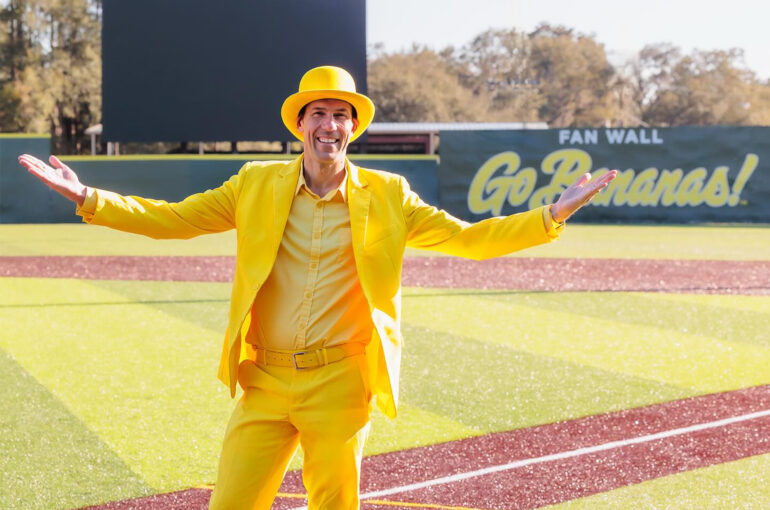
In the summer of 2016, professional baseball in Savannah, Georgia, was a corpse awaiting a burial. The Savannah Sand Gnats had departed for South Carolina, leaving behind a crumbling, historic stadium and a city that seemed largely indifferent to its loss. Enter Jesse Cole, a man who famously sold his house to keep a new team afloat and began wandering the streets of Savannah in a bright yellow tuxedo, desperately trying to convince locals to buy tickets to a team named after a fruit. At that moment, Cole was a classic American underdog—a hustler in the vein of Bill Veeck, trying to save the “National Pastime” through pure, unadulterated kitsch.
Fast forward to today, and the Savannah Bananas are no longer a struggling minor league curiosity; they are a multi-million dollar media juggernaut with a waitlist for tickets that rivals the Super Bowl. But in this transition from local scrappiness to global ubiquity, something fundamental has shifted. The Bananas have moved from being a baseball team that does stunts to an entertainment company that uses baseball as a loose framework for TikTok-optimized choreography. It is a transformation that mirrors our broader cultural pivot: a world where the “thing itself”—whether it be sport, journalism, or art—is increasingly treated as a mere delivery mechanism for “The Content.”
The Timeline of a Yellow Revolution
The evolution of the Savannah Bananas can be viewed in three distinct acts. The first act (2016–2018) was defined by radical accessibility. While Major League Baseball (MLB) struggled with declining youth interest and agonizingly slow game times, Cole’s “Fans First” philosophy was a breath of fresh air. They eliminated ads from the stadium, capped ticket prices, and made all-you-can-eat concessions the standard. The baseball was still recognizable, but it was wrapped in a carnival atmosphere that felt genuinely communal.
The second act (2019–2021) saw the birth of “Banana Ball.” This wasn’t just baseball with fireworks; it was a fundamental rewriting of the rules to suit a shorter attention span. Two-hour time limits, the banning of bunts, and the rule where a fan catching a foul ball results in an out. This period marked the team’s pivot toward social media dominance. It was no longer about who won the game in Savannah; it was about which clip of a pitcher performing a backflip went viral on Instagram that night.
The third act, which we are currently inhabiting, is the era of the World Tour. In 2023, the Bananas officially dropped out of the Coastal Plain League—their actual competitive league—to become a full-time professional barnstorming circus. They are now the Harlem Globetrotters of the diamond, playing against their own permanent foils, the Party Animals. The transformation is complete: they are no longer competing in a sport; they are executing a touring theatrical production.
The Conflict of the “Un-Game”
This shift has not occurred without friction. While the Bananas are celebrated in business circles and marketing seminars as “disruptors,” traditionalists and even some long-term fans view the current iteration with a degree of skepticism. The primary conflict lies in the loss of stakes. In sports, the drama is derived from the uncertainty of the outcome. In “Banana Ball,” the drama is choreographed.
Industry analysts at outlets like Forbes have noted that while the Bananas have solved the “boredom” problem of baseball, they have replaced it with a relentless, high-octane stimulation that leaves little room for the quiet tension that defines the sport’s history. Peer reactions within the industry have been a mix of envy and dismissal. MLB has taken note, implementing its own pitch clock and rule changes in 2023 to mimic the Bananas’ pace, yet the “serious” sports world remains wary of a model that prioritizes a viral dance break over a strategic pitching change.
The media framing has shifted accordingly. Early coverage focused on the heartwarming story of a small-town team saving a stadium; current coverage, such as recent features in Rolling Stone, treats the Bananas as a case study in the “Experience Economy.” They are no longer reviewed as athletes, but as influencers with gloves.
The Admission of Strategy
Jesse Cole has never been shy about his intentions, which makes the “authenticity” debate around the team particularly interesting. He has explicitly admitted that the baseball is, in many ways, secondary to the marketing. “We’re not in the baseball business, we’re in the entertainment business,” Cole has stated in numerous interviews with outlets like CNN.
In his book, Fans First, Cole acknowledges that the goal was always to eliminate the “boring parts” of the fan experience. This is a strategic provocation. By labeling the core tenets of a 150-year-old sport as “boring,” Cole didn’t just change the game; he signaled that the game’s traditional value was no longer sufficient to sustain a business in the modern attention economy. This is a radical admission of the power of the “Short-Form” era. The Bananas didn’t just happen to go viral; they were engineered from the ground up to provide 15-second bursts of dopamine that fit perfectly into a vertical video player.
Cultural Analysis: The Death of the “In-Between”
The Savannah Bananas are the ultimate symptom of a culture that has lost its tolerance for “the in-between.” In baseball, the “in-between” is the silence between pitches, the slow build of an inning, the psychological warfare between batter and pitcher. In a broader sense, our culture is currently engaged in a war against silence and stillness. Whether it is the gamification of education or the “content-ification” of politics, we are increasingly unable to engage with any subject that does not provide immediate, rhythmic feedback.
This reflects a deeper transformation in how cultural authority is gained. In the past, a sports team gained authority through winning—through the accumulation of history and the “sacredness” of the record book. Today, authority is gained through reach. The Bananas have more TikTok followers than the New York Yankees not because they are better at baseball, but because they are better at the performance of baseball.
This raises the question of Authenticity vs. Performance. If a fan goes to a Bananas game and has the best night of their life, does it matter that the “competition” was a scripted exhibition? For many, the answer is a resounding no. But when everything becomes an exhibition—when our news, our art, and our sports are all filtered through the lens of “entertainment value”—we lose the ability to value things for their intrinsic qualities. We begin to value them only for their ability to distract us. The Bananas aren’t just a team; they are a visual representation of the modern media ecosystem, where the “spectacle” is the only thing that remains real.
Conclusion: The Weight of the Yellow Tuxedo
The rise of the Savannah Bananas is an American success story, but it is one that carries a heavy set of questions for the future of our cultural institutions. Jesse Cole succeeded because he realized that the “National Pastime” was out of step with the National Attention Span. He didn’t fix baseball; he turned it into something else entirely.
As the Bananas continue their sold-out tour across Major League stadiums, they represent a world where the boundary between “the event” and “the promotion” has dissolved. Their current strategy carries immense weight because it works—it fills seats, it sells merchandise, and it creates joy. But in a changing environment where even the most viral moments are quickly forgotten, one wonders if the Bananas can maintain their relevance without eventually running out of stunts.
When the backflip catch becomes routine and the choreographed dances become predictable, what is left? If the sport itself has been hollowed out to make room for the show, the show must never stop. The Savannah Bananas have won the battle for our attention, but in doing so, they have shown us exactly how much we are willing to sacrifice for a good time. In the end, the yellow tuxedo isn’t just a costume; it’s a flare gun, signaling the moment when the game ended and the content began.